By Sarah McCrea
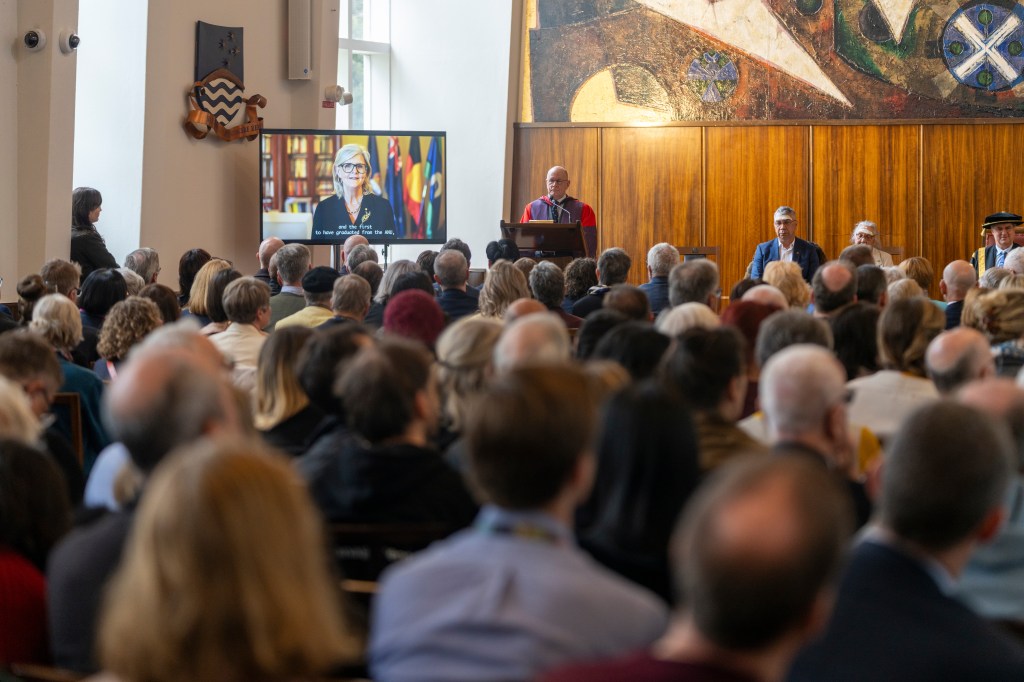
After six and a half years of closed doors, University House was re-opened on Friday 14 August, 2026. However, the re-opening served another purpose: the launch of the ANU’s University Strategy, ANU by 2030.
During a ceremony to celebrate both events, Current Chief Minister of the ACT and former ANU student Andrew Barr officially opened University House, presented with a key by the Master of University House, Professor Peter Kanowski. Interim Vice-Chancellor of the ANU, Professor Rebekah Brown, was then given the key on behalf of the ANU community.
“University House has always been more than a building. It’s where scholars, students and visitors come together to exchange ideas and build the kind of community that has made ANU one of the world’s great universities,” remarked Chief Minister Barr.
The re-opening aligns with the ANU’s 80th anniversary celebrations, an occasion to reminisce on the rich history of the ANU and the University’s founding commitment to knowledge and understanding. This was a commitment that many of the speakers referenced throughout the ceremony, and a commitment reflected in ANU by 2030.
ANU Interim Vice-Chancellor Professor Rebekah Brown spoke at the ceremony to introduce ANU by 2030. She stated the strategy was built on “two fundamental contributions”, the first “disciplinary, peer-tested knowledge” and the second “problem-solving” in a practical, real-world sense.
“Our strategy says they’re the same obligation, seen from two directions, and that’s something to be genuinely excited about,” Brown stated. The three pillars ANU by 2030 focuses on are research, education and student experience, and convening.
For students, parts of the strategy may already be starting to become visible. Brown revealed the ANU was “applying the final touches to the ANU Vice-Chancellor Scholars Program”, stating this program would be looking to “back students for whom circumstance, geography or history has made their path to university harder”.
Acting Pro-Chancellor and Council member, Mr Andrew Metcalfe, also spoke at the ceremony.
Metcalfe urged the audience to “remember that the story of ANU is not written by buildings, strategies or milestones alone. It is written by people”.
With his revelation that the ANU’s new Chancellor will be announced in the coming days, there will be a new leader writing the story of the ANU. Further, at least one current leader will be leaving their post. Metcalfe announced that the Interim Chancellor, Dr Larry Marshall, will retire from Council when the new Chancellor commences office. This marks yet another Ministerial appointment who will resign from Council before their scheduled term ends.
Despite this, for the ANU, Friday was a day to focus on the future: on ANU by 2030. The strategy held a strong commitment to the First Nations community, particularly in research. It stated “We are the stewards of Indigenous collections and data, and work in partnership with Indigenous researchers and communities”.
ANU by 2030 summarised the University as carrying a “distinctive advantage” in the nation’s capital and holding “spheres of influence” in the territory, in the nation, and in the Asia and Pacific stage. For the section of education, there was a strong focus on accessibility, student pathways, and employability.
The most unique aspect of ANU by 2030 focused on the University as a place for “convening”.
“We will bring together cross-sectoral expertise to address the critical questions facing the nation that require a national response,” the strategy read. “We will create the conditions that make this work possible by investing in the people, spaces, partnerships and alumni networks that turn inquiry into national benefit”.
“The measure of this work is what changes because of it, in policy, in practice, and in public understanding. “
Determining what this looks like in practice may have to wait until the Implementation Plan.
Earlier in the day, Interim Vice-Chancellor Professor Brown faced the media.
“[W]e’re in a transition in our governance,” she acknowledged. “[O]ur incoming Chancellor and our next forthcoming substantive Vice Chancellor will have a real role in shaping how we realise the intent of our strategy.“
The University Strategy referenced “a sustainably sized, thriving and diverse student cohort”. When asked about this, Brown clarified, “We ideally need to be a higher [student] population”. She outlined the intent to have a greater focus on the revenue side of the University’s finances, such as from student enrolments, a side she admits has been overlooked in recent years.
Another focus of questions was AI, which is increasingly prevalent in educational and administrative spaces at the ANU.
“We’re already using AI at ANU,” Professor Brown commented, referring to AI use for administrative tasks. She stressed that “we want to make sure we’re using it well and we’re using it well and we’re really deliberate. It’s really to support our people so we spend our time being deliberate with our efforts”.
She remarked, for use of AI in students’ work and learning, that it was “really informing our pedagogy, our curriculum, and our research”. Brown stated the ANU is taking “deliberate steps to ensure our graduates are AI fluent in whatever discipline areas they’re undertaking”.
This decision on AI comes at odds with many student and staff perspectives, but it aligns with the future-first strategy which Brown stated is at the core of ANU by 2030. She said there are still “fundamental principles” of the ANU, but added the University is “investing in that, but looking at how we do that for a new age, for the next eighty years.”
The question of what a new age looks like and how much change it entails will likely come with the Implementation Plan. If the ANU governance’s commitment to community consultation and co-design is kept, students, staff, and the community will be able to shape this new age, for “the next eighty years”.
If not, students and staff might be awaiting a second Renew ANU.
More to come.
Photography provided by Jamie Kidston/Australian National University.
Know something we don’t know? Email news@anuobserver.org.
If you have an issue with this article, or a correction to make, you can contact us at news@anuobserver.org, or angry react the Facebook post.
If you don’t have an issue with this article and want to hear more from us, we’re in the process of making a newsletter! Sign up here, and have the latest news delivered directly to you.

