By Dylan Voyles and Roland Wall
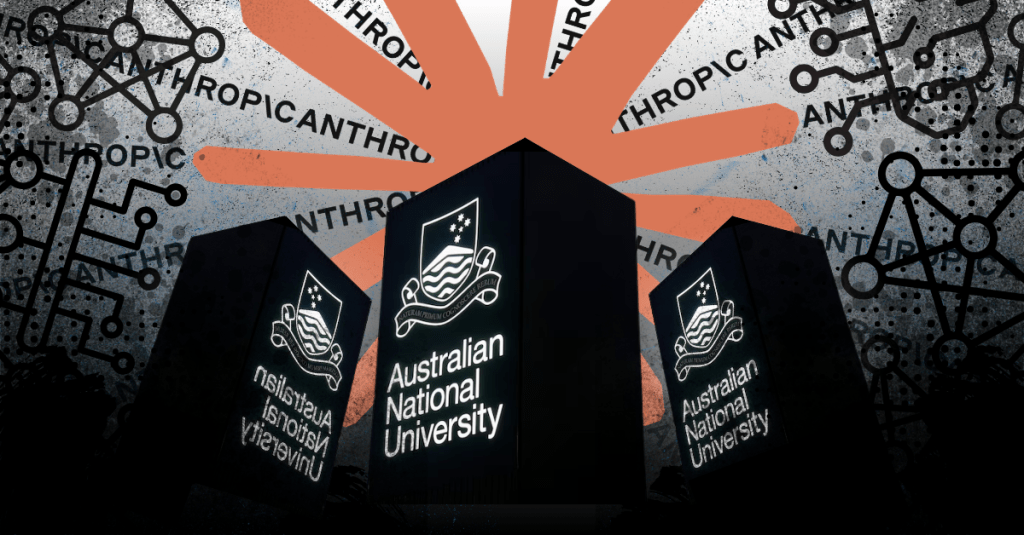
The ANU School of Computing has started providing students with access to Artificial Intelligence (AI) tools through a donation of API credits from AI company Anthropic.
Professor Alex Potanin, who is leading the deployment of Claude Code at the School of Computing, said the A$500K donation will support teaching by giving students access to Claude Code, a leading large language model (LLM) tool for software development.
Potanin stressed the arrangement is “not a partnership” but a donation with “no strings attached”. It is separate from an Anthropic partnership with the John Curtin School of Medical Research. The initiative is designed for teaching, not research, and will be optional for students.
“We teach AI in a very educationally-focused manner,” Potanin said, adding that students are expected to understand both the capabilities and limitations of AI systems.
“Nowadays, LLMs are absolutely used in the workplace. It is a perfect case to teach the limits and uses of LLMs.”
Rather than requiring students to purchase subscriptions, the ANU is building a proxy system that authenticates users through university infrastructure before routing requests to Anthropic’s servers in the United States.
Students will be granted access through their courses, allowing the university to manage costs and usage while keeping individual identities hidden from Anthropic. Students will retain all intellectual property rights to their work.
Potanin said privacy was another factor behind the choice. Anthropic encrypts traffic, doesn’t use student interactions to train future models, and deletes all data after 30 days.
Equity is another key motivation, he noted. Some students had already paid for AI subscriptions or access services, such as GitHub Copilot, through educational plans. However, institutionally managed access ensures all students can use the same tools, regardless of individual students’ financial circumstances.
The School of Computing is also adapting its teaching to reflect AI’s growing role in industry. Introductory programming courses will continue to prohibit AI to ensure students fully understand foundational concepts. More advanced subjects, however, such as agentic AI courses and TechLauncher capstone projects, will teach students how to use AI critically and effectively.
An exception to this is COMP1730, an introductory course dedicated to teaching programming language Python to non-computing students, where students will have the opportunity to access these donated Claude Code credits.
Verifying the authenticity of AI-generated material will be covered in courses.
“These systems are probabilistic,” Potanin said, noting that AI ”hallucinations” and errors remain unavoidable with the use of AI.
Potanin discussed how the initiative will also help inform the ANU’s long-term AI strategy. The School plans to evaluate student usage and industry trends as an alternative to investing in current computing infrastructure.
In the near future, there is the opportunity to purchase used hardware at a reduced cost and build its own server on campus. There are no plans to pay for a subscription in the future. “This is a long-term trial,” Potanin said.
“If we can have the best theoretical program and top-notch tools, that’s the best possible outcome for graduates.”
While Potanin affirmed that the use of AI would be taught in a prescriptive and “educational-focused” manner, with expectations regarding AI use made clear to students in all courses, students across ANU have reported some uncertainty surrounding the role of AI in coursework.
ANUSA’s 2025 Generative AI report found that while three-quarters of ANU students use AI in some form, only 37% of them felt they understood what ANU expected of them in relation to generative AI usage.
Part of the confusion is that ANU’s academic integrity rules have not been updated since 2021, before LLMs became mainstream. This leaves all guidance on AI usage to be issued on a course-by-course basis. This is what allows COMP1730 to distinguish itself from other introductory programming courses, granting it greater freedom in generative AI usage.
More to come.
Graphic by Harry Dennis.
Know something we don’t know? Email news@anuobserver.org or use our anonymous tip submission.
If you have an issue with this article, or a correction to make, you can contact us at news@anuobserver.org, submit a formal dispute, or angry react the Facebook post.
If you don’t have an issue with this article and want to hear more from us, we’re in the process of making a newsletter! Sign up here, and have the latest news delivered directly to you.
Want to get involved? You can write articles, photograph, livestream or do web support. We’re also looking for someone to yell “extra!” outside Davey Lodge at 1AM. Apply today!

