By Ella Kwak and Sadie McGrath
Often joked about as the ANU “Hunger Games”, Inward Bound (IB) is the ANU’s annual orienteering ultramarathon, running for more than 60 years. Teams of four from each residential hall and the wider community race on foot to reach Endpoint, where they are welcomed by crowds of family, friends, and supporters. The catch: they have no idea where in the bush they are.
Every year, overmore than 200 willing ANU students run through night and day for the approval of the “navigational gods”. Observer speaks to participants and Committee members to evaluate whether they’ve lost their minds or found something the rest of us are missing.
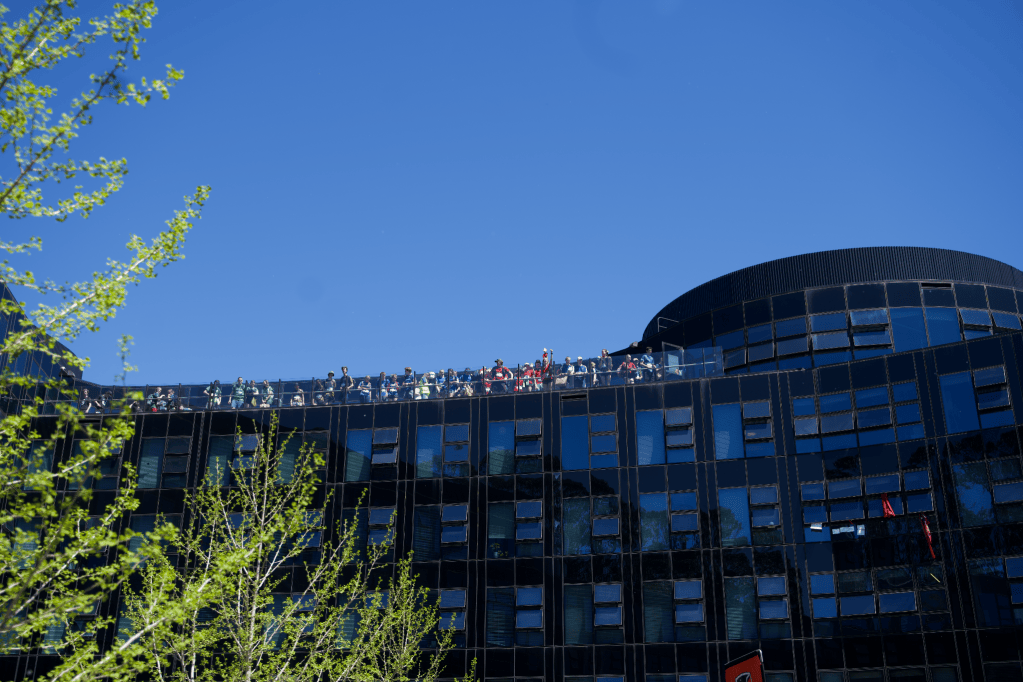
This year, hundreds of ANU residents gathered to farewell overmore than seven divisions of teams into the wilderness. They were blindfolded, loaded onto blacked-out buses, and driven for an unspecified amount of time to various secret locations in the bush. They were left there with only a map, a compass, and anywhere from fifty to a hundred kilometres standing between them and Endpoint.
To outsiders, it makes very little sense, and those involved know it. One former Burgmann Division 7 runner, who volunteered in this year’s event, recounts theirconvoy stopping for fuel on the way to the drop. Volunteering, she said, made her realise that outsiders, “most definitely think we are crazy”.
“We pulled up to a petrol station at about 10:30pm with three blacked out buses, 60 blindfolded runners and a car with this huge radio antenna.”
The 2026 course setters described their philosophy as “diverging and converging”. This meant splitting teams onto different routes, then bringing them back together. They achieved this through exclusion zones, areas on the map that teams are banned from entering, which forced teams to choose between several similarly viable routes. Later, those routes merged again, forcing rivals to cross paths. One Div 3 Burton & Garran (BnG) runner recounted their team finding out only after the race that they were disqualified in the first 15km for entering an exclusion zone.
Some runners reported the course to be “pretty smooth sailing until the end”, mostly consisting of single trail running and fire trails, with multiple “bush bash” options across all divisions.
However, the course was not without its challenges.
Most runners agreed that the biggest physical feat was the mandatory bush bash, one to two kilometres from Endpoint. Teams were told that rather than taking Mores Road, they must climb a hill and bush bash down the other side.
For many, it took more than an hour, and it was in this leech-infested part of the course that the majority of the thirteen teams that failed to finish were forced to DNF, pulled from the bush with a plethora of injuries.
A Wamburun runner reported that “[the course] was basically off a cliff… it was the type of thing [where] if you tripped, you honestly would just tumble down to the bottom”. The course setters admitted it “might demoralise some teams”, and some runners agree that “IB might have put a sour taste in a lot of people’s mouths because of the way that they just played mind games a little bit too much across the whole thing”.
Despite the brutal finish, it was Bruce Hall who emerged as this year’s overall winner, ahead of Griffin Hall in second place and John’s College in third. Division honours were spread across six halls: Fenner Hall took out Division 1, Griffin won Divisions 2 and 6, Bruce claimed Division 3, B&G won both Divisions 4 and 5, and Ursula Hall won Division 7. Further down the table, Wamburun finished eighth, but celebrated a milestone of its own: the hall’s first ever Division 3 finish.
IB is just as much a mental game as a physical one. Each year, runners are pushed to their limits, both physically and mentally, emerging from the bush covered in scratches and bruises and on the verge of collapse. We spoke to runners across all different teams, and they labelled IB as one of the “hardest things [they’ve] ever done”.
The preparation for IB begins months out, with training runs, nighttime “mock drops” and qualifying rogaines for navigators. Most Residential Halls even observe sober periods before the race.
A Wamburun Hall coach said that their sober period ran for three to four weeks, while BnG reportedly banned drinking for months.
In the final days before IB, runners carb-load on what one B&G runner described as “bags and bags and containers of pasta and rice”. Another runner from Wamburun even claimed to be having multiple cold showers a day, training “not just the physical fitness side, but also training [his] brain”.
Most runners spoke passionately of their experiences and how “doing hard things like this” forces you to realise how much more you are capable of. They spoke of applying the lessons learnt from IB to lots of different areas of their lives, with one runner describing how she could “compare everything in [her] life to this [IB] now”. Another runner reminisced about how “it really puts things into perspective, how easy we’ve got it”.
When Observer asked runners how they made it to Endpoint, almost none credited their months of preparation and training. Instead, nearly all of them pointed to their teammates. “If we were going alone, [we] probably would have quit,” one Wamburun Division 3 runner said.
A former Burgmann runner-turned-volunteer put simply that “running isn’t what hooks people; it is the community”. She had never been on a run before training for her first IB, and turned up with Coles water bottles and a zip-lock bag of sour worms. Against all odds, she finished twice.
After the bush bashing, power lines, and mind games, it’s fair to ask what could possibly make it worth it. For the runners, the prize was never the medal.
Runners describe the “great community” of IB and that is a great way to meet like-minded people, bonding over hours spent running and bush bashing through Canberra’s bushlands.
One runner spoke of seeing IB “help people through eating disorders, [and] mental health disorders” such as anxiety and depression. Much like a run club, for many people, IB is just as much a way of staying fit as it is a community and support network.
The navigational gods may have been unforgiving at the course’s end, but ask competitors whether they’ll be back, and the answers sound like those of true believers.
“Yes, of course,” exclaimed one competitor, “I’m definitely doing it next year”.
Is it crazy? Maybe. But before you rule it out, ask yourself when you last pushed yourself that far, alongside people who refused to let you quit. If the answer is never, the navigational gods are always recruiting.
Photos taken by Ella Kwak
Know something we don’t know? Email news@anuobserver.org or use our anonymous tip submission.
If you have an issue with this article, or a correction to make, you can contact us at news@anuobserver.org, submit a formal dispute, or angry react the Facebook post.
If you don’t have an issue with this article and want to hear more from us, we’re in the process of making a newsletter! Sign up here, and have the latest news delivered directly to you.
Want to get involved? You can write articles, photograph, livestream or do web support. We’re also looking for someone to yell “extra!” outside Davey Lodge at 1AM. Apply today!

