By Madeleine Crabtree
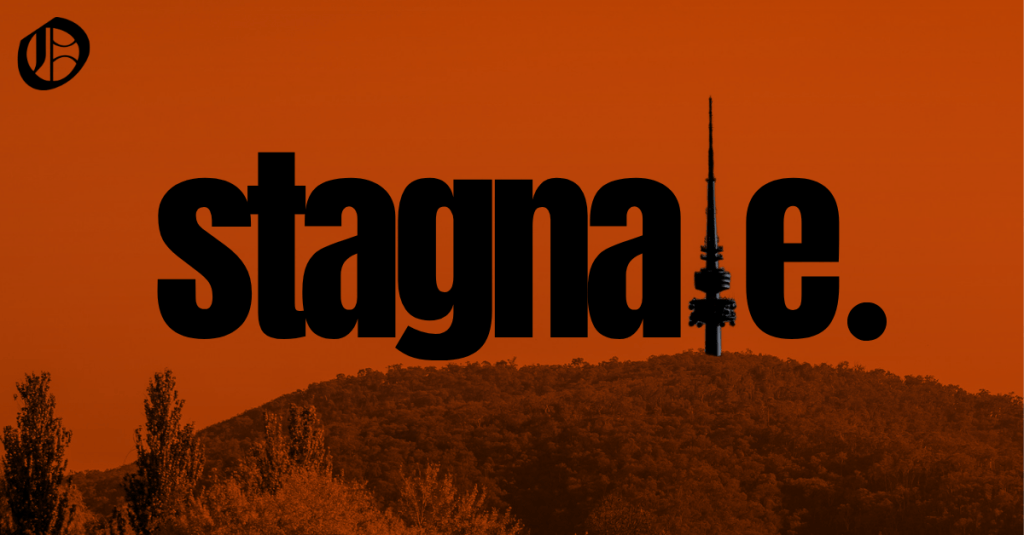
Tom McElvogue from the one-man ticket, Stagnate Your ANUSA, shocked ANU students during the ANUSA elections when he became the final delegate elected to the National Union of Students (NUS). In this role, he will represent the ANU’s student union at the National Conference of the NUS (NatCon), at which he has promised he will “eat dozens of pieces of paper so nothing can be discussed”.
Hungry for more success, the Stagnate candidate has announced via an Instagram post last week that he would be running for ACT State Branch President of the NUS (SBP). In the post, he claimed that he holds the “deciding vote” for the election for the position. A candidate needs over 50 per cent of the vote from other delegates to be elected as president.
The ANU is the only university represented in the ACT Branch of the NUS, meaning the six delegates from ANUSA are the only eligible voters. McElvogue claims that there is currently a deadlock between ANUSA’s Labor-affiliated and non-Labor affiliated delegates. And he’s not the only one.
Malakai King, another delegate for the NUS, explained how votes were allocated for delegates. Each union is allocated one vote per 500 equivalent full-time student load (EFTSL). The ANU’s EFTSL last year was around 17,720. This meant that last year, ANUSA had 36 votes split between six delegates, equating to six votes each.
King stated that if ANUSA’s EFTSL stays the same for this year, there will be a tie between Labor-affiliated and non-Labor-affiliated delegates. If, however, the number of votes is not divisible by the number of delegates, they are distributed in the order of which delegates were elected.
Observer notes in this year’s election, the first two candidates elected as delegates were Labor-affiliated (Leila Clarke and Aurora Neumann). As a result, if the EFTSL changes, there will no longer be a tie in the vote. If there is a tie at any stage of the count, the candidate to be eliminated will be drawn by lots.
The ANU’s EFTSL numbers have not been finalised yet, with King stating that “it’s too early to tell what the State Branch President elections will look like”. He also added that both of Elevate’s delegates, himself and Tully Leonard-Kelly, would be meeting with all the other delegates “to ensure [they] are most effective on behalf of the students who voted for us”.
Observer spoke to McElvogue, to learn more about his decision to run for ACT Branch President. He answered that it would be “hilarious” if he, as a self-proclaimed joke candidate, got the position, and that he would use this power “to then execute [his] policy platform onto the only university in the ACT which is part of the NUS”, this being the ANU.
On a more serious note, he stated that “no one knows what the NUS is or what it does”.
“Most students are just trying to survive their degrees, pay rent, and get through the week without swimming in the cesspool of student politics. The onus shouldn’t be on everyday students to know what their elected leaders are doing for them, it should be the leaders informing the students.”
To answer this question for students, Observer spoke to Leila Clarke, the current ACT SBP for the NUS. She explained that the SBP is an unpaid role, and has a vote on the national executive of the NUS. Their job is to deliver reports on what is happening within their state or territory and what they have been doing in their roles.
Clarke described some of the things she has been doing this year in the role of SBP. These include working on getting an independent student union at the University of Canberra, working with the ACT government to implement better occupancy agreement laws, speaking at the Students say no to Hanson rally, and advocating for the abolishment of the Job-Ready Graduates scheme.
McElvogue made it clear that he was not arguing that the NUS or SBPs do nothing, but that they do not inform students of their existence and of their achievements. This is especially important because students pay for the representation, with funding for delegates attending the NUS coming out of the Student Services and Amenities Fee (SSAF). According to a 2024 report, 55 per cent of SSAF in that year was allocated to ANUSA, adding up to over $3.5 million. From this amount, ANUSA’s 2024 Provisional Budget allocated $40,000 to funding NUS.
McElvogue summarised that he was running “because no one knows that the NUS is and that is messed up. I think we’re better off with the NUS than without it, but I think it’s just silly that no one knows that the branch president does”.
When asked why he would make a “good” SBP, he replied that he had “no idea”, as there was very little for him to compare himself against.
“What I can guarantee you is transparency. You’ll always know what I’m doing and how I’m trying to do it. I’ve got plenty of joke policies to let your imagination run wild, but even if I got elected and chose to do absolutely nothing, at least you’d all be aware of it.”
The lack of interaction with the NUS perhaps points to the larger issue of low engagement in student politics throughout the ANU. Woroni reported that in the 2026 ANUSA elections, voter turnout was only 10.52 per cent of eligible voters. Despite this low number, this was the highest turnout since 2022.
More to come.
Graphics by Anushkaa Ahuja
Know something we don’t know? Email news@anuobserver.org or use our anonymous tip submission.
If you have an issue with this article, or a correction to make, you can contact us at news@anuobserver.org, submit a formal dispute, or angry react the Facebook post.
If you don’t have an issue with this article and want to hear more from us, we’re in the process of making a newsletter! Sign up here, and have the latest news delivered directly to you.
Want to get involved? You can write articles, photograph, livestream or do web support. We’re also looking for someone to yell “extra!” outside Davey Lodge at 1AM. Apply today!

