
By Madeleine Crabtree
From 23 to 24 March, ANU’s National Security College (NSC) held their flagship conference: ‘Securing our Future: a ready and resilient Australia’. The event included sessions on a variety of topics ranging from policy direction in national security to the importance of social cohesion.
Observer sat down with Professor Rory Medcalf, who has been Head of NSC for over a decade. He described the conference as “a respectful national conversation based on the evidence of public opinion”. This evidence was taken from NSC’s Community Consultation initiative which involved over 20,000 Australians from across the country.
When asked about the importance of the initiative, Professor Medcalf stated that NSC believed it was “high time to form a baseline of data of what the community thinks” on national security. He commented on “the growing gulf” between the government and community in approaching national security challenges, and the problems of policy being set out in Canberra, which is often seen as a “bubble”.
The importance of combining community and government views was also highlighted in the session ‘Australians all: social cohesion in our multicultural democracy’, which Professor Medcalf said “brought out the best of what we were trying to achieve”. This is available to be watched online, as are other sessions from the conference.
The topic brought together a panel of speakers from various backgrounds, moderated by Lydia Khalil, Program Director for Transnational Challenges at the Lowy Institute. She described the conference as “bridging that gap in conversation between the broader community and us tradespeople who work on national security”.
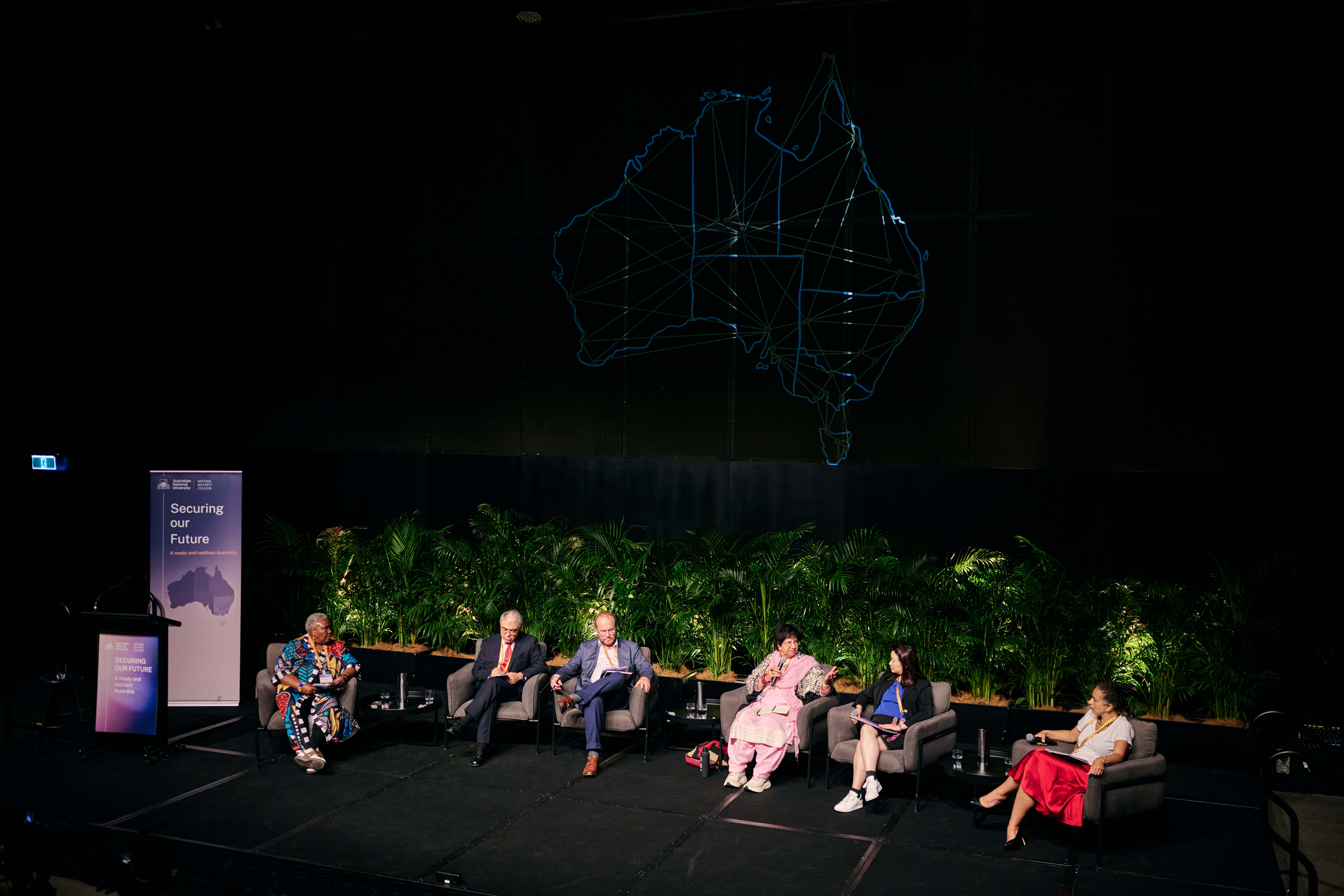
In particular, the session focused on the meaning of social cohesion. Panelist Professor Sameena Yasmeen from the University of Western Australia, described her idea of it as “not one where everyone thinks and acts in the same way. It’s a community consisting of communities and networks and interactions”.
Professor Medcalf stated this was an overarching theme of the conference, being “how do you build a tolerant, cohesive, resilient, democratic community?” This is a particularly prevalent question for Australian society today, especially in the aftermath of the December 2025 Bondi terrorist attacks.
When asked about the difficulty of organising the conference in such a volatile period of international relations, such as the US-Israeli attacks on Iran, and in light of the recent terrorist attacks, Professor Medcalf acknowledged there are “high and rising anxieties about security”. This can be seen in data from the Community Consultation initiative, which indicates that concern about Australia’s national security went from 42 per cent in November 2024, to 64 per cent by February 2026.
However, Professor Medcalf also emphasised “it’s really important to distinguish that this isn’t pure panic”, and that recent events have made it even more important to hold conferences like ‘Securing our Future’. He added the ANU was the “right platform” for these difficult conversations, as a place in which people can be brought together and “have big ideas”. This year over 50 ANU students were among 450 delegates coming from all over Australia to attend the conference.
Another session at the conference focused on First Nations’ perspectives on national security. Professor Medcalf noted the importance of hearing the voices of First Nations people. One of the three major reports making up the Community Consultation initiative was a focus on First Nations’ perspectives. Its author, Pascale Taplin, a PhD candidate at NSC, completed work in the Northern Territory and Far-North Queensland.
Professor Medcalf made reference to the “underappreciated role” played by First Nations communities in national defence. This was highlighted in Taplin’s report through a quote from an interviewee in North Queensland. They stated, despite a long history of First Nations people protecting this country, “there’s still a pervading thought that not everybody has a part to play”.
The same session also focused on the importance of shared security with neighbouring countries such as New Zealand and Papua New Guinea. Professor Medcalf described this relationship as helping Australia to gain a “recognition that security isn’t just about protecting your borders”, with much more pressing issues in the Pacific, including climate change.
He added that Australia has a lot to learn from New Zealand, firstly in community resilience in the face of atrocities, with the Christchurch terrorist attack in 2019, but also in how their resilience is linked to the role of the Maori community in Aetearoa/New Zealand. Thus, though this conversation was not “the core of the conference”, it is certainly “a really important part of the bigger picture”.
Another session was titled ‘The day after tomorrow: intergenerational security’, run by the NSC Futures Hub, a center for structured thinking about the future. The session focused on the importance of engaging the next generation in national security, as the policies made today will impact them in the future. It involved a panel of young voices and exercises for the audience, many of whom were students, with a future-focused set of scenarios for them to vote on.
Professor Medcalf called integrating intergenerational voices “the core of our mission”, and something NSC has been focused on for a long time.
An example of this was the Australian Crisis Simulation Summit, a student-led initiative at the ANU which, every year, brings in students from across the country to participate in an intensive crisis-simulation activity. Professor Medcalf mentioned the role of NSC, as well as other institutions within the ANU like the College of Law, Governance, and Policy, in providing support, mentoring, and funding for the event. He also made reference to NSC’s ‘Emerging Associates’ program which gives a platform to around ten emerging voices around Australia.
The conference overall provided the environment for NSC to discuss the results of their Community Consultation initiative, helping to achieve what Professor Medcalf described as a goal “to reduce the gap between what the government thinks it knows about the security problems the country faces, and what the community perceives”.
“It could be that one side or the other is right, one side or the other is wrong, could be that they’re both wrong. But a first step is evidence.”
More to come.
Graphics by Anushkaa Ahuja
Know something we don’t know? Email news@anuobserver.org or use our anonymous tip submission.
If you have an issue with this article, or a correction to make, you can contact us at news@anuobserver.org, submit a formal dispute, or angry react the Facebook post.
If you don’t have an issue with this article and want to hear more from us, we’re in the process of making a newsletter! Sign up here, and have the latest news delivered directly to you.
Want to get involved? You can write articles, photograph, livestream or do web support. We’re also looking for someone to yell “extra!” outside Davey Lodge at 1AM. Apply today!

