By Sarah McCrea
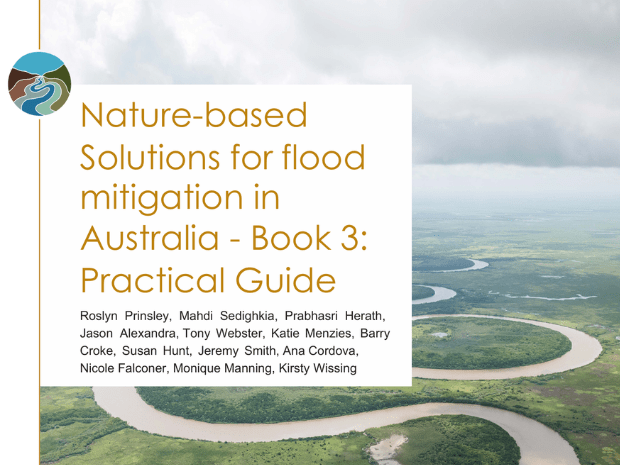
A multi-disciplinary team of ANU researchers have released three books of national guidelines on Nature-based Solutions (NbS) for flood mitigation. These are the results from a long-term project – centred at the ANU Institute for Climate, Energy, and Disaster Solutions – which explores alternative approaches to mitigating flood potential and impacts beyond conventional or ‘grey-flood control’ solutions such as dams.
The guidelines explain these NbS focus on “working with natural systems, rather than against them”, and also provide co-benefits for communities and the environment.
Observer spoke to Dr Roslyn Prinsley, one of the leading researchers in the field and a key researcher in the project. She explained there’s a lot of discussion globally on NbS, but also “there’s not much data or ‘how-to’ information”.
The findings show that NbS have three key strategies: detaining, diverting, and reducing energy and the extent of floodwater.
Types of NbS include “landscape solutions”, which look at catchment areas and involve measures such as reforestation, and “stream and floodplain-based solutions”, which include strategies like restoring riverbank vegetation. There are also “storage solutions” and “diversion solutions” which directly interact with water bodies such as rivers and streams. NbS can also be used in combination with conventional infrastructure intended for flood mitigation.
The findings are available here (including Book 3 as a practical guide) and provide a comprehensive overview of the project.
Although the project also had a significant “science side”, it also had a strong emphasis on community engagement, with six catchment studies undertaken in three partner communities.
Global research on NbS has largely focused on their applications in urban areas, such as installing ‘green roofs’. However, Prinsley says “they’re actually not that effective at mitigating large riverine floods… The only way to really use Nature-based solutions to mitigate large riverine floods is to work in the whole catchment.”
A catchment is the area of land where water flows towards a single point. The amount of water in this area depends on the surrounding environment, climate, and the size of the catchment.
According to Dr Prinsley, in riverine areas susceptible to large flooding, effective management often involves a combination of solutions such as reforestation, increased vegetation around water bodies, and installing leaky weirs. However, when working on the whole catchment, this work may extend onto private properties, requiring activities like replanting or the installation of infrastructure such as leaky weirs. Prinsley commented on the importance of working with communities and property owners to collaborate on how this occurs.
While information related to cost-effectiveness exists for more conventional flood control measures, it is harder to quantify for newer approaches such as NbS. While the lack of cost-efficiency data presents a barrier to adoption at present, Prinsley believes greater application of this research will help to close the knowledge gap.
Prinsley also pointed out the co-benefits of implementation, that “you not only get flood mitigation, but you also get improvements in water quality, reductions in erosion, improvements in biodiversity, increased carbon sequestration.”
“But on the other hand, that makes it much harder to measure those benefits, because they’re spread out over so many areas, and it’s hard to work out: what is the economic benefit of increased numbers of koalas?”
Another barrier to adoption is cooperation with governments and standards. Prinsley referenced a catchment in Queensland where NbS infrastructure is being constructed with the intention of slowing down floods, reducing flood peaks, and improving water quality.
Despite these benefits, Prinsley mentioned “the Queensland Government is concerned that ‘we don’t understand enough about what’s going to happen to the fish passage side of things.’”
She said that there are legal obstructions to the application of NbS, calling it “expensive” and “time-consuming” to reach the stage of application. She further added,“ if you’re doing something that’s good for the environment, it shouldn’t be [this] hard.”
“Some people in the government would really like to help you to make it easier [to implement]. And other people are just real sticklers for whatever the law is.”
The project seeks to fill this gap in knowledge on NbS for flooding. Prinsley says, “in the end, you’ve got to actually work in a particular location that has major problems with floods, with a community that understands the location and understand the problems they have and how they might address those problems, or work with you to do that.”
When asked about opportunities for undergraduates to get involved in the research, Prinsley stated, “there’s a lot of different aspects: social research, institutional research, hydrological modeling, environmental research…we’re always keen to have students work with us.”
The project is now expanding to apply the guidelines to different catchments.
Graphics by Laudine Cao
Know something we don’t know? Email news@anuobserver.org or use our anonymous tip submission.
If you have an issue with this article, or a correction to make, you can contact us at news@anuobserver.org, submit a formal dispute, or angry react the Facebook post.
If you don’t have an issue with this article and want to hear more from us, we’re in the process of making a newsletter! Sign up here, and have the latest news delivered directly to you.
Want to get involved? You can write articles, photograph, livestream or do web support. We’re also looking for someone to yell “extra!” outside Davey Lodge at 1AM. Apply today!
 ANU Observer