Written by Anushka Vineet
2025 was the year of advocacy.
The student population was out in full force, protest attendance was at an all-time high, and there was palpable outrage in the air.
It seemed that the ANU was constantly in the news, normally in a negative light, with adjectives like outrage, indignation and anger, constantly used to describe the ANU community.
However, within the anger, it cannot be understated that some seemingly positive change did occur. With the rollback of the College of Arts and Social Sciences (CASS) changes, as well as the School of Music and the National Dictionary Centre staying open, the role of advocates in our community continues to be invaluable.
One such advocate was Thomas Emerson, MLA. As a member of the ACT Legislative Assembly, his seat of Kurrajong encompassed the ANU campus. As such, many issues that students faced were issues that were his duty to voice.
But who is he? You may have seen him walking around campus, you may have seen him on social media, or have heard of his movement studio, Praksis. However, Mr Emerson has been a long-time community advocate.
Observer sat down with Mr Emerson to discuss his political journey from former ANU student to member of the ACT Legislative Assembly.
He himself was a former ANU student graduating in 2016 with a Bachelor of Philosophy (Honours). Like many students, Mr Emerson had a tumultuous academic career as he did not start studying Philosophy; in fact, he started with Advanced Computing (which lasted two weeks).
Emerson hailed his time at university and emphasised that the skills he learnt are still applicable in his day-to-day life. One of the most important takeaways from his degree was the “value of doing something I felt passionate about, felt invested in learning about, and that gave me a new perspective on the world and tools to engage with the world”.
By partaking in the PhB program, Mr Emerson noted that he thrived under the freedom that it offered him. Discovering a range of different philosophical conundrums and topics helped him gain different perspectives that he could apply to a range of different contexts. An ethics course taught him how to apply “an ethical lens to a decision-making process”. Mr Emerson hails that learning how to apply a “critical lens on our society is something that’s ultimately served [him] in politics”.
After starting his movement studio, Praksis, he saw the positive effects of community building. For him, “starting a movement studio was always about building community, and trying to create a space where people could be fully who they are and vulnerable and open with each other”.
He notes that many are “missing that kind of environment in our lives… [and] we need to do more to create more spaces where people can connect with each other”.
Seeing this stark disconnect, Mr Emerson entered politics.
He concedes that within the community, “people feel like there’s this massive gap between politics and them”. He explains that the ordinary person believes that there is a disconnect between the average politician and the community.
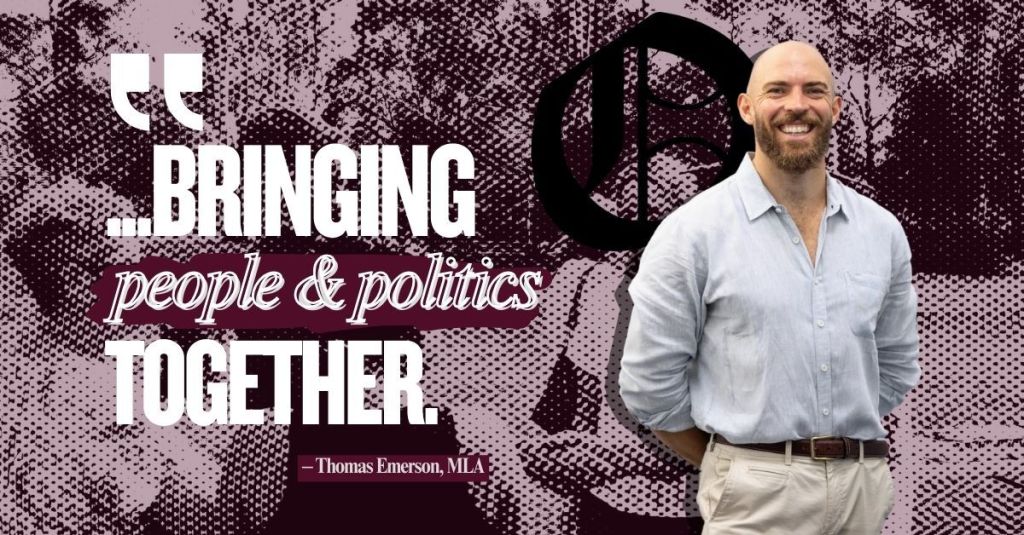
Hence, his political mission is “about bridging the gap and bringing people and politics together”. He strives to ensure that “people feel heard and seen by the people who are paid to represent them”.
With his seat of Kurrajong encompassing the ANU campus, the voices of students are something that Mr Emerson strives to hear. He acknowledges the unspoken truth: that Canberra is “fundamentally a student town”. However, he admits that the connections between the local government and students are severed.
“Students are a huge part of our culture, and so we should celebrate [them] and make sure their voices are heard”.
Acknowledging that many students come from out of town, Mr Emerson stresses that it is the job of “elected officials to connect more with students”. It is paramount that politicians “hear their [students] perspectives, to understand why the decisions we’re making are affecting them”.
He acknowledges that more can be done, as “many politicians will know that some of these students aren’t registered to vote in the ACT, and that can influence who they want to speak with”.
In August 2025, Mr Emerson was a constant presence on campus, attending the Don’t Stop the Music Protests and the No Cuts ANU Protests. Some might remember seeing social media video interviews that he may have done with your friends.
Mr Emerson acknowledges the uncertainty that shrouds the ANU regarding its future, and emphasised that the ACT Government can do more.
Even though the ANU is a Commonwealth Institution, “it is a core part of our [Canberra’s] community”. Many Canberrans study and work at the ANU, and Mr Emerson, when chatting with many such members, notes that most “haven’t heard from their local [government] member”.
“There is a lot that the ACT Government can do when it comes to lobbying the federal government to act and prevent poor decisions from being made”.
With the massive technological shifts and the rise of AI, Mr Emerson emphasises the necessity of the arts and that they are being massively undervalued within Australian universities. With the diminishing of the arts and humanities, Mr Emerson echoes the sentiments of advocates across Australia that AI can never replicate the “critical thinking [and] reflecting on society” which makes us inherently human.
With such problems, Mr Emerson urges students to reach out, as he loves “hearing from young people in particular, and anyone who doesn’t feel represented”. As mentioned above, it’s the reason he entered politics: to represent the voices that go unheard.
Through visiting mobile offices and conferences to reaching out via social media platforms, Mr Emerson, as an Independent, strives to be as in touch with the community as possible. He wants to “take community concerns into Parliament” and follow in the legacy of other independents, “like David Pocock to change the face of politics”.
Similar to last year, Mr Emerson is hoping to hold more mobile offices on campus and get in touch with more students.
When asked about future plans that Mr Emerson is pushing for the student, he noted a piece of legislation that would change the government’s accountability to future generations.
Currently, his team “is working on a piece of legislation that would make it an obligation on the government to prioritise the well-being of current and future generations in their decisions”. This is similar to the Future Generations Bill championed by Dr Sophie Scamps.
Mr Emerson states that the “biggest issue that we face is intergenerational inequity”. There is a fundamental disconnect between societal expectations and outcomes for young people. He conveys that many “young people do not have the same opportunities their parents had, and feel like they’re completely set up to fail”.
Such a bill will “address that young people are our greatest asset” and we must be creating conditions in which they are able to thrive. Such a bill will hopefully foster longer-term governmental thinking when “too many people feel that the system isn’t just broken, but is actually against them”.
With the ANU churning out politicians like it’s butter, Mr Emerson emphasises that anyone who would like to consider a future in politics, public service or community advocacy, should act as soon as they find their passion, and “move in that direction quickly”.
“There’s a certain magic to doing the things that you’re most passionate about that can attract other people to [support] you to do those things”. And passion should be at the forefront of politics.
Observer would like to thank Mr Emerson for his time. Anyone who would like to get in contact with Mr Emerson is encouraged to do so via his social media platforms, his mobile offices or his email. All information can be found on his website.
Graphics by Anushkaa Ahuja
Know something we don’t know? Email news@anuobserver.org or use our anonymous tip submission.
If you have an issue with this article, or a correction to make, you can contact us at news@anuobserver.org, submit a formal dispute, or angry react the Facebook post.
If you don’t have an issue with this article and want to hear more from us, we’re in the process of making a newsletter! Sign up here, and have the latest news delivered directly to you.
Want to get involved? You can write articles, photograph, livestream or do web support. We’re also looking for someone to yell “extra!” outside Davey Lodge at 1AM. Apply today!
 ANU Observer