Written by Amelia Gordon
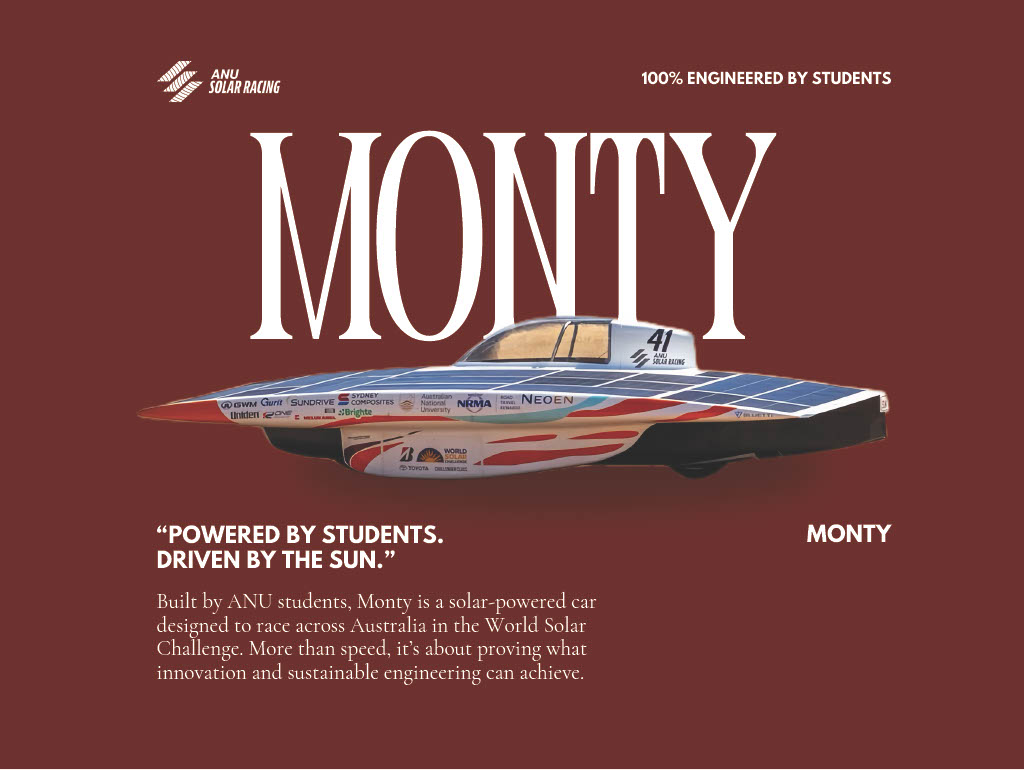
ANU’s Solar Racing team is preparing to push the limits of student innovation. Their car, Monty, doesn’t just run on sunlight — it’s a feat of engineering that sets it apart from previous iterations and competitors alike. As they gear up for the World Solar Challenge, the team isn’t just racing for speed; they’re racing to prove what sustainable engineering can achieve.

ANU Solar Racing is the ANU’s official solar racing team. It is 100 per cent run by students who design, build and compete in the biennial Bridgestone World Solar Challenge, a race from Darwin to Adelaide, competing alongside 37 teams from 18 countries.
Observer spoke with Luke Sissons, a member of the ANU Solar Racing Team, to discuss the work the team has been doing and what they have accomplished so far.
Sissons is currently in Darwin working with the team in preparation for the upcoming Bridgestone World Solar Challenge.
“The proudest part of the car (which makes it unique from previous iterations) is the fact that the car sails. We pushed our airfoil profiles to be as useful for sailing as possible, so we can be much more effective in crosswinds”.
“The challenge we needed to overcome with this is that sailing can be a bit difficult to achieve with an asymmetric design (asymmetric because we have two wheels on the right and only one centred on the left). For clarification, sailing helps us achieve a thrust effect in a crosswind. Our chassis design philosophy was crafted with crosswinds in mind and the air foils we have chosen facilitate this as we saw in our simulations and testing period”.
Sissons explained the unique category in which solar cars exist, distinct from other EV markets.
“The biggest misconception is probably differentiating what the competition promotes as a solar-powered vehicle and what an in-market electric vehicle is. An electric vehicle or EV can be charged by solar panels, but it does not necessarily mean that solar arrays are on the car itself. Our solar-powered vehicle is specifically designed to have the array on the vehicle as opposed to just being charged by it”.
The vehicle operates at an “net neutral speed”, “usually 70-80km/h”. Energy is preserved for “hills, cloudy days and overtakes”.
“We take every opportunity we have to charge the battery, and simulations indicate how much we should be able to get from charging at stops, which gives us an idea of how much we can use and how much we can gain. Also, most of the energy draw comes from acceleration so remaining at a steady state minimises energy consumption. The sim helps us dictate this speed as well. These simulations work by analysing weather conditions and the car’s statistics to determine an energy-optimal speed. All of this is to say that even when sunlight isn’t guaranteed, unless it is a downpour, we have the option to continue running the car with our battery”.
In preparation for the World Solar Challenge, the ANU Solar Racing Team took Monty to Coober Pedy for its most extensive round of testing yet. The outback town provided the perfect environment to simulate the harsh conditions of the Stuart Highway, though it came with its challenges.
Despite setbacks caused by weather and dust interference with electrical and mechanical components, the Coober Pedy trials were a milestone. They allowed the team to refine Monty’s performance off-grid, building confidence ahead of the race to Darwin.
“By running these tests earlier, the unexpected are addressed sooner and have a better chance of being avoided in the race”.
Anticipating challenges extends well beyond testing. When it comes to pushing the limits of solar technology, the team has had to strike a delicate balance between efficiency and durability.

The solar cells integrated into Monty’s top shell had to maximise power while also contributing to the car’s aerodynamic design. Built with semiconductors that reduce resistive losses, the chosen cells allow for stronger performance even under shade or patchy sunlight. Striking the balance between resilience and efficiency proved challenging, but the team is confident they succeeded.
The biggest lesson learnt from previous competitions is ensuring that there is ample time for testing and working on the car. This entails striking a balance among aerodynamics, aesthetics, software, and solar efficiency.
“The main reason we want to maximise the solar array area is so we can maximise the power available to be drawn by the motor. Aerodynamics is also important, particularly at high speeds, and reducing the size of the array space means we can reduce weight, and it also gives less time for turbulent air to trip. Air running over the modules is also very important for cooling. The solar team try to ensure that the solar array is as smooth and tightly packaged as possible to accommodate aerodynamic flow”.
“The team collaborated with SunDrive to implement the 272 HJT cells which were fabricated on site with SunDrive. The battery management system we currently have has actually been optimised from the previous iteration. This year we have put emphasis on automatic cell balancing in addition to integrating more temperature sensors and in-built cell balancing systems. It is all quite complex, but the electrical team have done a fantastic job to understand and implement these processes. These factors should help with race performance as these components were implemented on the basis of optimising our car at any given point. With our add-ins and fixes, Monty should be able to run the best it can under any given circumstance”.
The team’s use of sponsor support allowed them to tackle complex issues that testing and management of the vehicle’s system raised.
“Our software system is actually in collaboration with one of our sponsors, Marple. Their website is data analysis, more specifically specialising in time series data. The importance of Marple for our data analysis comes down to three main aspects: race simulation, weather conditions and live telemetry from the solar car”.

Overall, the experience has changed the way students have learnt about solar power and software, something that you can’t always learn in a regular classroom where the focus is on research and theory. The solar car provides an opportunity for students to apply engineering and mathematical concepts in a real-world and highly competitive setting. The team say the experience has helped shape their career aspirations and helped them to determine where they want to direct their skills in the future.
Working on Monty, the team gained confidence not only in problem-solving but also in communication and teamwork.
“As university students, this is an invaluable experience and certainly not something I expected to be as critical as it has been”.
“It is simply an unmatched experience that you don’t often get the chance to do, and above all, it is a cool trip across Australia. Getting to challenge yourself and having the opportunity to learn about a process and manufacturing you wouldn’t otherwise learn in a classroom is super awesome. You also get to experience this journey with like-minded people and contribute to something that looks like it belongs in Star Wars. I would highly recommend the project if you’re keen to build something unique and work alongside motivated students and industry professionals”.
The Bridgestone World Solar Challenge takes place from 24 – 31 August.
Graphics by Fatima Usman
Know something we don’t know? Email news@anuobserver.org or use our anonymous tip submission.
If you have an issue with this article, or a correction to make, you can contact us at news@anuobserver.org, submit a formal dispute, or angry react the Facebook post.
If you don’t have an issue with this article and want to hear more from us, we’re in the process of making a newsletter! Sign up here, and have the latest news delivered directly to you.
Want to get involved? You can write articles, photograph, livestream or do web support. We’re also looking for someone to yell “extra!” outside Davey Lodge at 1AM. Apply today!
 ANU Observer