By Patricia Hill
Have you ever been reading the headlines plastered with (quite often) bad news, and thought, “I reckon I could solve that” or more commonly: “What were they thinking?!”.
Well, each year a selection of quick-minded delegates do just that at ANU, putting their heads together to solve a crisis.
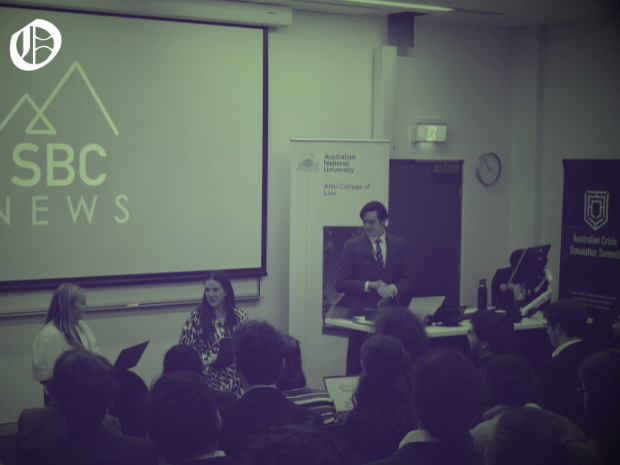
The Australian Crisis Simulation Summit (ACSS) is a national student-run organisation that hosts a summit each year at the ANU. This year’s summit will take place between September 1 – 4, where delegates partake in two days of a simulated crisis simulation, as well as panels and workshops.
Undergraduate students not only participate in the summit, but also organise the event and write the simulations. Observer sat down with Emma Deering, Head Crisis Writer for the regional simulation, to discuss what the opportunity is all about.
Emma was introduced to the program at an ANU College of Asia and the Pacific (CAP) orientation and applied online.
“I walked in basically having very little knowledge about the ACSS and what we did… by the end of it, [I] loved it so much that I thought I’d come back for 2025 and help organise”.
Emma is now the Head Crisis Writer for the regional simulation, which is no small feat. “We’ve been working on this since February… brainstorming at least since then, if not before that.
“We go through about three drafts… each draft gets feedback from mentors and industry professionals from different parts of government”.
It is a creative process, with the simulation looking to Australia’s future.
“We’ve spent a lot of time doing world building, what we want the world to look like in the future, where we’ve set the simulation, how we think the government and their processes have developed, and how they’ve changed over time.”
The simulation is put into a software, which feeds out new developments, tweets, and news articles in real time. In teams of five, delegates are assigned roles and must respond to these advancements via collaboration and negotiation.
“It’s really active participation in government.”
Before heading into the simulation, delegates receive training and attend panel events.
“We had intelligence panels last year, media training… other events, like networking opportunities, where they go and meet with mentors and other experts in the field”.
If you’re studying security, international relations, or want to enter government at any level, the ACSS is full of opportunities.
Emma studies law and international security, finding it “incredibly helpful doing this at the same time as studying… It really complemented all of my international security studies… [It] adds a whole other dimension to what you’re learning theoretically with a more practical sense of the purpose behind it.”
Applications for the 2025 summit are closed, but those interested can follow this year’s summit here.
Graphics by Shé Chani with photography from the ACSS
 ANU Observer