By Sarah McCrea
Former ANU student Andrew Barr has been Chief Minister of the ACT since 2014 and a Member of the Legislative Assembly (MLA) representing ACT Labor since 2006.
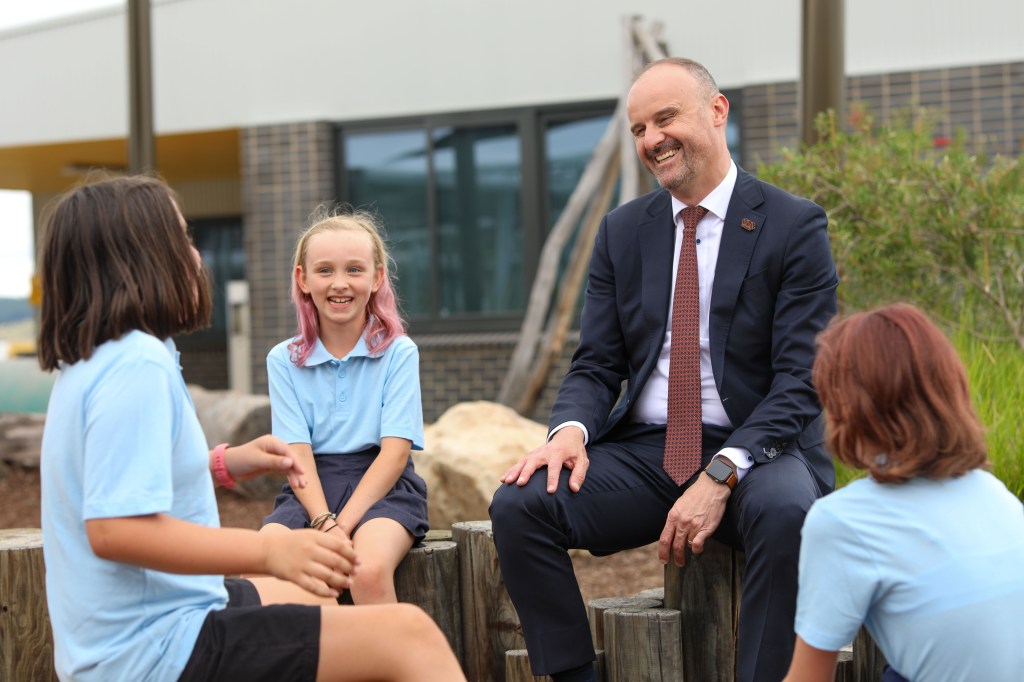
Observer sat down to chat with the Chief Minister about his work and how it affects students in the ACT.
Barr attended the ANU in the 1990s, studying economics and political science. During his time at university, he was involved in student politics, notably serving as ANUSA Treasurer and a member of Young Labor.
Reflecting on what he learnt during this time, he said, “Those skills are useful in almost any post-academic work environment. You certainly learn about having to work with people who have often very different views and perspectives on how certain things should be done, or how you might approach addressing a problem, or what the problem even is.”
“It’s a valuable thing. It gives people a bit of perspective and understanding on what [being in] elected office actually means.”
He added, “But I would just say – to reflect upon my career – you’re only in your twenties once, don’t have politics consume all of that. There’s got to be time for fun, experience, travel…if you’re so focused on politics and campaigns and all that sort of thing, you might suddenly find that years have gone by that you just don’t get back.”
Regarding the pathway to politics for young people, Barr referenced his own experience working in an MP’s office and commented on the “advantages in having a bit of a look and a try before you sort of really wade into the deep end.”
However, he also recognised, “It’s also good that there are people who run [for politics] who aren’t and have never been part of the system, and they can bring an entirely different perspective to the role.
“A good parliament has a little bit of all of that, that there are some people who have that background and understanding, others who come in from entirely different perspectives.”
Barr’s work has a strong focus on education, including tertiary education. Canberra’s universities operate under different legislation from different levels of government; hence, the ACT government has varying levels of jurisdiction over the university sector.
For example, the ANU operates under an act from the Federal government, which is its primary source of funding. The ANU is accountable to the Federal government, and its operating Act includes several legal and regulatory frameworks to abide by. However, the University of Canberra operates under an act from the ACT Legislative Assembly, where the legal framework for the university’s operation and governance is instead set by the ACT government, which also provides funding to the university.
Despite this complexity, Barr stated, “We do seek to work with the universities. There’s an organisation within the ACT government called ‘Study Canberra’, who work with the universities on a range of things, like coordinating the open days. I have an annual Chief Minister Student Welcome that we do at the beginning of the academic year, where we invite all the new students, international and domestic, to this welcome event.”
“A really interesting example [of government involvement in universities] is the Canberra Innovation Network, which is an entrepreneur start-up support organisation, where each of the universities are founding partners, together with the ACT government and some corporate sponsors.”
Returning to the topic of diversity and perspectives in Parliament, Barr discussed his experience thirty years ago.
“For a large number of people, they may not have seen a pathway to be an elected representative. That old adage, you can’t be what you can’t see.”
He added that diversity in politics helps those from underrepresented groups “to see there is a pathway forward in elected representation.”
“There’s certainly [this change] as a result of some pretty direct interventions for the Labor Party and how people are pre-selected to be candidates in the first place.”
ANU has no shortage of students with political aspirations, and Barr commented on his own desire to get involved in politics, which started whilst he was still studying.
“It was certainly something I was interested in. I hadn’t come out when I was at uni – that probably was a year or two later – and for a couple of years, I just thought: Well, that’s it. There are no gay politicians. No one’s voting for a gay politician. So I’ll just give up on that and focus on other things.”
“There were a couple of years of coming to terms with all of that. Then I thought: well, maybe I’ll never know if I don’t try, and we’ll see what happens…I would have been 25 turning 26 when I came out, and then, eight years later, I ran [for politics] for the first time.”
But despite a general positive shift in attitudes towards the LGBTQ+ community, Barr revealed, “I still get emails and nasty social media messages that will be not so much about policies, but about my sexuality… It’s still there, even in 2025 and even for someone who’s been around in the system for nearly 20 years.
“You are on display. You are. You’re in politics, it [identity] is a very public thing that can be a factor, but in a positive way as well as a negative way.”
The Chief Minister expanded on this ‘positive’ way of identity as a factor in politics, commenting that there’s “a tendency for voters to want to vote for a candidate who’s like them, or who understands their experiences. So in our [ACT] elections, there’s a very strong ‘women’s vote’, where there will be voters who will only vote for the women candidates, and they’ll do so across political parties.”
So, there’s been a significant change in the world of politics, with Barr referencing social attitudes, increasing diversity, new trends in constituents’ voting, and also the general path to getting into politics. Barr also discussed what other changes might be upcoming, or emerging already.
“What we are going to see over the next few sets of elections in Australia is the last of the Boomers exiting the political system, where Gen X’ers will end up being the old timers, and there’ll be a lot more Millennial representation, and start to be Gen Z representation.
“There’s [now] a much stronger focus on intergenerational equity. Debates around housing affordability policies that relate to climate change and sustainability are much more prevalent than was the case 25 years ago. Increasingly there will be debates over the role artificial intelligence is going to play in workplaces and society. And probably also tax, because Australia’s tax settings at the moment – I think there’s a very strong argument to say – are too favourable for older people and quite unfair for younger people.”
But how is the ACT government intending to shape this future?
The Chief Minister discussed one of his government’s key priorities: looking after older people and keeping them “healthy and independent.” He further mentioned, “there’s going to need to be more investment in healthcare and aged care, but then I think technology is going to assist a lot more.”
Another priority was mental health, with Barr commenting particularly on the role of social media, acknowledging “whilst it’s done some amazing things in enabling people from all over the world to be able to communicate with each other and keep in touch, it might also have made people lonelier.”
He remarked, “It’s just a very different, different world, and that needs some thinking around how we’re going to respond to that over time.”
Quotes may have been edited for clarity and/or grammar.
Know something we don’t know? Email news@anuobserver.org or use our anonymous tip submission.
If you have an issue with this article, or a correction to make, you can contact us at news@anuobserver.org, submit a formal dispute, or angry react the Facebook post.
If you don’t have an issue with this article and want to hear more from us, we’re in the process of making a newsletter! Sign up here, and have the latest news delivered directly to you.
Want to get involved? You can write articles, photograph, livestream or do web support. We’re also looking for someone to yell “extra!” outside Davey Lodge at 1AM. Apply today!
 ANU Observer